
Hibernate
Enroll in the best Hibernate training in Indore at Rays Technologies. Learn Hibernate ORM, mapping, and integration with hands-on projects.
Hibernate
Hibernate is a robust Object-Relational Mapping (ORM) framework for Java, facilitating seamless interaction between Java applications and databases. It maps Java classes to database tables and automates SQL query generation for CRUD operations. Key features include automatic SQL generation, lazy loading for optimized performance, and caching to minimize database access.
| Duration | 2 Weeks | Class Hours | 1 hour/day |
| Lab Hours | 1 hour/day | Prerequisite | Knowledge of Core Java |
| Certificate | After successful completion of training | Trainer | Industry Experienced Mentor |
| Study Material | Books, Notes and Online Tests | Online Test | Unlimited |
| Project | Yes | Lectures In | English / Hinglish / Hindi |
| Fees | Please Call | Placement Support | No |
| Complimentary | Laptop Bag and T-Shirt | ||
About Hibernate
Hibernate supports complex queries through its Hibernate Query Language (HQL) and ensures efficient transaction management. By abstracting the underlying database interactions, Hibernate significantly reduces development time and effort, making it essential for building scalable, high-performance enterprise applications.
Key Features of Hibernate:
Object-Relational Mapping
Hibernate provides a framework for mapping object-oriented domain models to relational databases.
Automatic Table Creation
It can automatically generate database tables based on the Java classes, reducing the need for manual SQL scripts.
Query Language
Hibernate Query Language (HQL) allows developers to write database queries in an object-oriented manner, making it easier to work with complex data structures.
Lazy Loading
Hibernate supports lazy loading of objects, which improves performance by loading data only when needed.
Transaction Management
It provides built-in transaction management capabilities, ensuring data integrity and consistency.
Complete Hibernate Syllabus
8 Modules · 2 Weeks
The syllabus for Hibernate covers a range of topics that are essential for understanding and effectively using the Hibernate framework in Java applications.
-
- Overview of ORM Frameworks
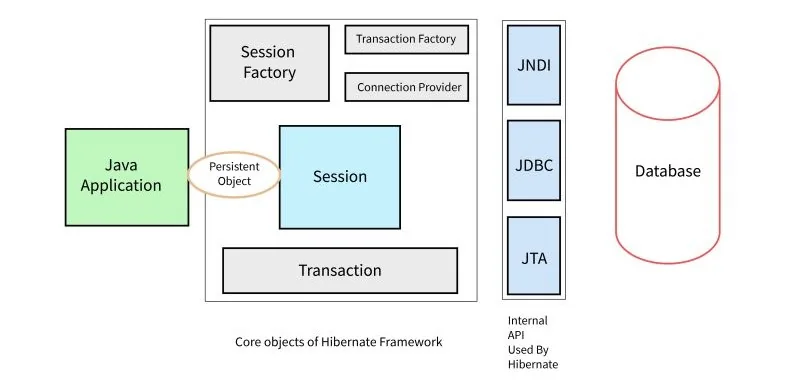
- Introduction to Hibernate Architecture
- Setting up Hibernate Configuration
-
- Mapping Java Classes to Database Tables
- Primary Keys and Foreign Keys
- One-to-One, One-to-Many, and Many-to-Many Relationships
- Inheritance Mapping
-
- Basic HQL Queries
- Parameterized Queries
- Named Queries
- Aggregate Functions and Grouping
-
- Dynamic Queries with Criteria API
- Restrictions and Projections
-
- Mapping Entities with Annotations
- Annotation-based Configuration
-
- Transaction API
- Programmatic and Declarative Transaction Management
-
- First-Level Cache
- Second-Level Cache
- Query Cache
-
- Optimizing Database Operations
- Effective Use of Caching
- Managing Transactions
Why Should a Student or Professional Learn Hibernate?
- Efficient Data Handling: Hibernate simplifies database interaction and reduces the amount of code needed for database operations.
- Portability: Hibernate abstracts away database-specific details, making it easier to switch between different databases.
- Performance Optimization: Hibernate provides features for optimizing database performance, such as caching and batch processing.
- Integration with Frameworks: Hibernate integrates seamlessly with other Java frameworks like Spring, enabling rapid application development.
Learning Hibernate is essential for Java developers who want to build robust and scalable database-driven applications with ease.
Interesting Facts
Hibernate is a powerful and popular Object-Relational Mapping (ORM) framework for Java. It simplifies database interactions and helps developers manage complex data models with ease. Here are some interesting facts about Hibernate:
1. Created and Development
Origin
Hibernate was created by Gavin King in 2001 as an open-source project. It was developed to address the limitations of JDBC and provide a more robust and flexible way to handle database interactions in Java applications.
2. Object-Relational Mapping (ORM)
Key Feature
Hibernate is an ORM framework that maps Java objects to database tables. This abstraction layer allows developers to work with high-level object-oriented concepts while Hibernate handles the underlying database operations.
3. HQL (Hibernate Query Language)
Powerful Querying
Hibernate provides HQL, a powerful query language that allows developers to write database queries using Java objects instead of SQL. HQL is similar to SQL but operates on Hibernate’s object model.
4. Automatic Schema Generation
Convenience
Hibernate can automatically generate database schemas based on the mappings defined in Java classes. This feature simplifies the database setup process and ensures that the schema is synchronized with the object model.
5. Caching Mechanisms
Performance Optimization
Hibernate includes caching mechanisms, such as first-level (session) and second-level (session factory) caches, to optimize database access and improve application performance by reducing redundant database queries.
6. Transaction Management
Integrated Transactions
Hibernate provides built-in support for managing transactions, ensuring data integrity and consistency. It integrates seamlessly with Java Transaction API (JTA) and other transaction management solutions.
7. Support for Various Databases
Database Compatibility
Hibernate supports a wide range of relational databases, including MySQL, PostgreSQL, Oracle, and SQL Server. This flexibility allows developers to use Hibernate in diverse environments and with different database systems.
8. Lazy Loading
Efficiency
Hibernate supports lazy loading, a technique that delays the loading of related entities until they are needed. This approach improves performance by reducing the amount of data loaded into memory and optimizing database access.
9. Community and Ecosystem
Active Development
Hibernate benefits from a strong and active community that contributes to its ongoing development and provides extensive documentation, support, and third-party tools. This ecosystem ensures that Hibernate remains up-to-date and reliable.
10. Spring Integration
Seamless Integration
Hibernate integrates seamlessly with the Spring Framework, providing additional features and configuration options for managing persistence and transaction management within Spring-based applications.
Training Program Fee
Get Personalized Career Guidance
Our admissions team specializes in helping students choose the right career path for their goals.