
MEAN Fullstack
Enroll in our comprehensive full stack developer courses, including MEAN stack, Java full stack, and web development classes. Get started with expert-led training and become a certified full stack developer.
MEAN Fullstack
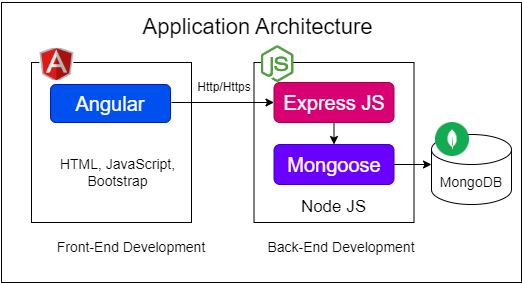
MEAN Stack development, consisting of MongoDB, Express.js, Angular, and Node.js, offers a full-stack JavaScript solution for building fast, robust, and maintainable web applications. Proficiency in MEAN Stack empowers developers to design, develop, and deploy modern web applications using JavaScript across the entire stack, enabling the creation of scalable and real-time applications that are highly valued in the software industry.
| Duration | 3 Months | Class Hours | 1 hour/day |
| Lab Hours | 2 hours/day | Prerequisite | Basic knowledge of programming |
| Certificate | After successful completion of training | Trainer | Industry Experienced Mentor |
| Study Material | Books, Notes and Online Tests | Online Test | Unlimited |
| Project | Yes | Lectures In | English / Hinglish / Hindi |
| Fees | ₹ 20,000/- + 18% GST | Placement Support | No |
| Complimentary | Laptop Bag and T-Shirt | ||
About MEAN Fullstack
MEAN Stack development promotes code reusability, simplifies the development process, and ensures seamless integration between frontend and backend components. Learning MEAN Stack enhances career prospects and provides opportunities to work on innovative projects and contribute to cutting-edge solutions in web development.
Following Key Topics to Cover in MEAN Stack Development-
5 Modules · 3 Months
-
- Introduction to Angular and TypeScript
- Components, Directives, and Services
- Routing and Navigation
- Forms and Reactive Forms
-
- Introduction to Node JS and Express.js
- Building RESTful APIs
- Middleware and Error Handling
- Authentication and Authorization
-
- Introduction to MongoDB and NoSQL Databases
- CRUD Operations and Data Modeling
- Aggregation Framework
- Indexing and Performance Optimization
-
- Consuming RESTful APIs in Angular
- Authentication and Authorization in MEAN Stack
- Error Handling and Validation
- Real-Time Communication with WebSockets
-
- Version Control with Git
- Continuous Integration and Deployment (CI/CD)
- Containerization with Docker
- Deployment on Cloud Platforms (e.g., AWS, Heroku)
Mastering MEAN Stack development enables individuals to create modern, scalable, and real-time web applications using JavaScript across the entire stack. This curriculum covers frontend and backend development, database management, frontend-backend integration, and deployment practices required to succeed as a MEAN Stack Developer. By acquiring these skills, you can build innovative web applications and advance your career in software development.
Why Should a Student or Professional Learn MEAN Fullstack Development ?
- Comprehensive JavaScript Solution: MEAN Stack provides a comprehensive JavaScript solution for full-stack development, enabling code reusability and seamless integration between frontend and backend components.
- High Demand: MEAN Stack Developers are in high demand in the software industry, as MEAN Stack enables the development of fast, scalable, and real-time web applications.
- Career Opportunities: Learning MEAN Stack development opens up diverse career opportunities in software development, web application development, and IT consulting.
- Innovation and Efficiency: MEAN Stack promotes innovation and efficiency in web development, allowing developers to build modern and responsive applications with ease.
Whether you're a student exploring career options or a professional seeking to enhance your skills, learning MEAN Stack development is a strategic investment that can lead to exciting career opportunities and professional growth in the dynamic field of software development.
Interesting Facts
The MEAN stack is a popular web development stack that includes MongoDB, Express.js, Angular, and Node.js. Here are some interesting facts about the MEAN Full Stack:
1. Components of the MEAN Stack
MongoDB
A NoSQL database that stores data in JSON-like documents, making it flexible and scalable for web applications.
Express.js
A lightweight web application framework for Node.js, used to build robust server-side applications and APIs.
Angular
A front-end framework developed by Google, known for its two-way data binding and component-based architecture, ideal for building dynamic web applications.
Node.js
A JavaScript runtime that allows for server-side scripting, enabling the use of JavaScript for both front-end and back-end development.
2. JavaScript Across the Stack
Unified Language
The MEAN stack enables developers to use JavaScript across the entire stack, simplifying the development process and improving efficiency.
3. Scalability
Scalable Architecture
MongoDB and Node.js provide a scalable foundation for MEAN applications, allowing them to handle a growing number of users and data.
4. High Performance
Efficient Data Handling
The combination of MongoDB's schema-less data model and Node.js's event-driven architecture ensures high performance for web applications.
Asynchronous Operations
Node.js supports asynchronous programming, which is essential for building non-blocking, high-performance web applications.
5. Front-End Power with Angular
Dynamic UIs
Angular provides powerful tools for building dynamic and responsive user interfaces, with features like two-way data binding and dependency injection.
Component-Based Architecture
Angular’s modular design promotes reusability and maintainability in large-scale applications.
6. RESTful APIs
API Development
Express.js simplifies the creation of RESTful APIs, making it easy to manage client-server interactions and data exchange in MEAN applications.
7. Rapid Development
Rich Ecosystem
The MEAN stack benefits from a rich ecosystem of libraries and tools, enabling rapid development and prototyping of applications.
8. Versatility
Adaptable to Various Applications
The MEAN stack can be used to build a wide range of applications, from single-page applications (SPAs) to complex enterprise solutions.
9. Open Source
Free and Open Source
All components of the MEAN stack are open source, allowing developers to freely use, modify, and contribute to the technology.
10. Community and Support
Strong Community
The MEAN stack has a large and active community that offers extensive resources, tutorials, and support for developers.
Training Program Fee
Get Personalized Career Guidance
Our admissions team specializes in helping students choose the right career path for their goals.