
C++ Language
C++ Language
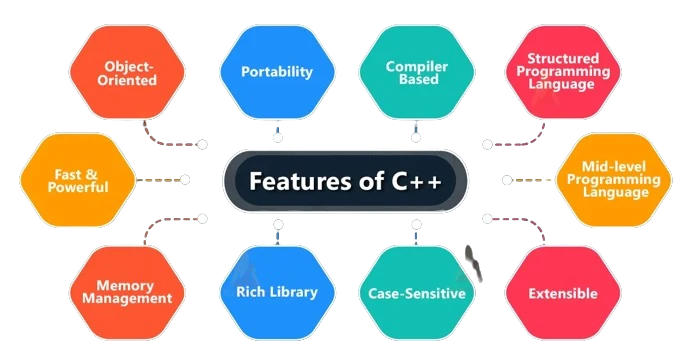
C++ is a powerful programming language developed by Bjarne Stroustrup at Bell Labs in the early 1980s. It is an extension of the C programming language with additional features such as object-oriented programming (OOP) capabilities and support for generic programming.
| Duration | 4 Weeks | Class Hours | 1 hour/day |
| Lab Hours | 1 hours/day | Prerequisite | Basic knowledge of C Language required |
| Certificate | After successful completion of training | Trainer | Industry Experienced Mentor |
| Study Material | Books, Notes and Online Tests | Online Test | Unlimited |
| Project | Yes | Lectures In | English / Hinglish / Hindi |
| Fees | ₹ 3000/- + 18% GST | Placement Support | No |
| Complimentary | T-Shirt | ||
About C++ Language
Renowned for its efficiency, flexibility, and performance, C++ is widely used in system software, game development, embedded systems, and large-scale applications where high performance and control over hardware are crucial. It combines low-level features of C with higher-level abstractions provided by OOP, making it suitable for both system-level programming and application development.
Key features of C++ include classes and objects, inheritance, polymorphism, templates, and exception handling. These features enable developers to write modular, reusable code and create complex software systems efficiently.
Complete C++ Language Syllabus
11 Modules · 4 Weeks
-
Overview of C++
- History and Evolution of C++
- C++ vs C
- Structure of a C++ Program
-
Basic Syntax
- Writing the First C++ Program
- Compiling and Executing a C++ Program
-
Data Types and Variables
- Basic Data Types
- Variable Declaration and Initialization
- Constants and Literals
-
Operators in C++
- Arithmetic Operators
- Relational Operators
- Logical Operators
- Bitwise Operators
- Assignment Operators
- Increment and Decrement Operators
-
Expressions and Statements
- Expression Evaluation
- Precedence and Associativity
- Type Conversions
-
Decision Making
- if, if-else, Nested if-else
- switch-case
-
Looping Constructs
- for Loop
- while Loop
- do-while Loop
-
Jump Statements
- break, continue
- goto
-
Introduction to Functions
- Function Declaration and Definition
- Calling Functions
- Function Prototypes
-
Parameter Passing
- Call by Value
- Call by Reference
-
Scope and Lifetime of Variables
- Local and Global Variables
- Static and Dynamic Scope
-
Function Overloading
- Basics of Overloading
- Overloaded Functions
-
Recursion
- Basics of Recursion
- Recursive Functions
-
Introduction to OOP
- Concepts of OOP
- Classes and Objects
-
Class Definition
- Declaring Classes
- Member Functions and Data Members
-
Constructors and Destructors
- Default Constructors
- Parameterized Constructors
- Copy Constructor
- Destructor
-
Access Specifiers
- Public, Private, and Protected Members
Encapsulation and Data Hiding
-
Inheritance
- Basics of Inheritance
- Types of Inheritance
- Constructor and Destructor Calls in Inheritance
-
Polymorphism
- Function Overriding
- Virtual Functions
- Abstract Classes
-
Operator Overloading
- Overloading Unary and Binary Operators
- Rules for Operator Overloading
-
Templates
- Function Templates
- Class Templates
-
Arrays
- One-Dimensional Arrays
- Multi-Dimensional Arrays
- Array Manipulation
-
Strings
- String Handling in C++
- String Class and Functions
-
Basics of Pointers
- Pointer Declaration and Initialization
- Pointer Arithmetic
-
Pointers and Arrays
- Array of Pointers
- Pointer to Array
-
Pointers and Functions
- Passing Pointers to Functions
- Function Returning Pointers
-
Dynamic Memory Allocation
- new and delete Operators
-
Basic File Operations
- Opening and Closing Files
- Reading from and Writing to Files
-
File Pointers and Their Manipulation
- seekg(), seekp(), tellg(), and tellp() Functions
-
File I/O with Streams
- ifstream, ofstream, and fstream Classes
-
Introduction to STL
- Components of STL
- Containers, Algorithms, and Iterators
-
Containers
- Sequence Containers: vector, list, deque
- Associative Containers: set, map, multiset, multimap
- Container Adaptors: stack, queue, priority_queue
-
Algorithms
- Sorting, Searching, and Other Algorithms
-
Iterators
- Input, Output, Forward, Bidirectional, and Random Access Iterators
-
Basics of Exception Handling
- try, catch, and throw Keywords
- Exception Handling Mechanism
-
Standard Exceptions
- Handling Standard Exceptions
- User-Defined Exceptions
Why Should a Student or Professional Learn C++ Language?
- Object-Oriented Programming: C++ is a powerful object-oriented programming language that allows for the creation of modular, reusable code through classes and objects.
- Performance and Efficiency: C++ provides high performance and efficiency, making it suitable for applications requiring fast execution and low-level manipulation of system resources.
- Compatibility with C: C++ is compatible with C, allowing developers to leverage existing C libraries and code, while also providing additional features such as classes, inheritance, and polymorphism.
- Application Development: C++ is widely used in developing applications, including operating systems, games, GUI-based applications, and real-time systems, due to its robustness and flexibility.
- Career Opportunities: Proficiency in C++ opens doors to diverse career opportunities in software development, game programming, system software, finance, and research, where performance and scalability are critical.
Whether you're aiming to build scalable software solutions or advance your career in specialized domains, learning C++ equips you with advanced programming skills and versatility that are highly valued in today's tech industry.
Interesting Facts
C++ is a powerful and versatile programming language with a rich history and many interesting facts. Here are some intriguing facts about C++ language:
1. History and Development
Origin
C++ was developed by Bjarne Stroustrup at Bell Labs in the early 1980s. It was initially called "C with Classes" and was intended to enhance the C language with object-oriented features.
Standardization
The first standardized version of C++ was ratified in 1998 (ISO/IEC 14882:1998). Since then, several major updates have been released, including C++11, C++14, C++17, and C++20.
Influence
C++ has influenced many other programming languages, including Java, C#, and even newer languages like Rust.
2. Language Features
Object-Oriented Programming
C++ supports object-oriented programming (OOP), which includes concepts like classes, inheritance, polymorphism, and encapsulation.
Templates
One of the powerful features of C++ is its template system, which allows for generic programming. This enables developers to write code that works with any data type.
Memory Management
C++ provides fine-grained control over memory management. Developers can allocate and deallocate memory manually using operators like new and delete.
Standard Library
The C++ Standard Library includes a rich set of functions and classes for data structures (like vectors, lists, and maps), algorithms, input/output, and more.
3. Performance and Usage
Performance
C++ is known for its high performance. It provides low-level access to memory and system resources, which is why it is often used in system programming, game development, and real-time applications.
Compatibility
C++ is largely backward compatible with C, allowing C++ programs to use C libraries. This compatibility has helped in the widespread adoption of C++.
Cross-Platform
C++ is highly portable and can be compiled on various platforms, including Windows, Linux, macOS, and many embedded systems.
4. Applications and Industry Impact
Widely Used
C++ is used in a variety of applications, including operating systems (e.g., parts of Windows and macOS), game engines (e.g., Unreal Engine), high-frequency trading platforms, and scientific computing.
Compilers
There are several popular C++ compilers available, such as GCC (GNU Compiler Collection), Clang, and Microsoft Visual C++.
Community and Support
C++ has a large and active community. Numerous resources are available, including books, online tutorials, forums, and conferences like CppCon.
5. Unique Aspects
RAII (Resource Acquisition Is Initialization)
C++ uses the RAII idiom to manage resource allocation and deallocation, which helps in preventing resource leaks.
Multiple Inheritance
Unlike some other OOP languages, C++ supports multiple inheritance, allowing a class to inherit from more than one base class.
Operator Overloading
C++ allows operators to be overloaded, enabling developers to define custom behavior for operators (e.g., +, -, *) for their own classes.
6. Fun Fact
Complexity: Despite its power and versatility, C++ is known for its complexity. There’s a famous saying: “C++ makes it harder to shoot yourself in the foot, but when you do, it blows your whole leg off.”
Training Program Fee
Get Personalized Career Guidance
Our admissions team specializes in helping students choose the right career path for their goals.